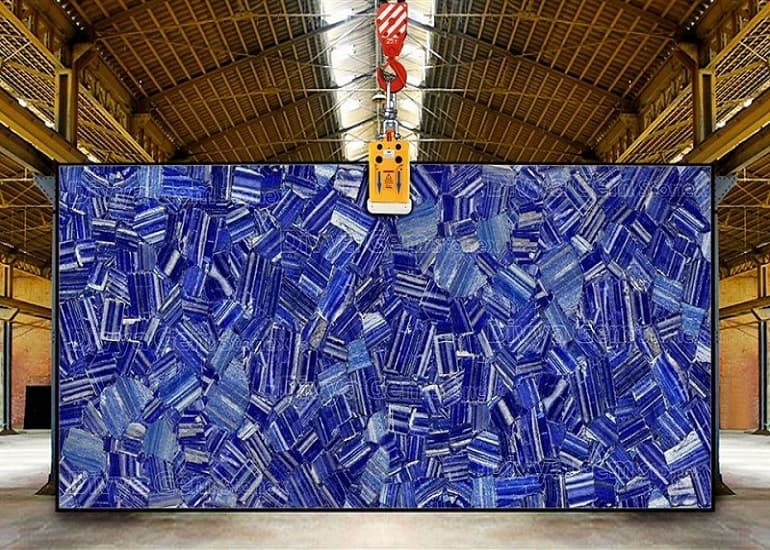
Lapis lazuli has been in demand for a very long time. Egyptian jewellers worked it, and Renaissance painters ground it into ultramarine, a famously expensive pigment. What you are actually buying is a rock, mostly lazurite with calcite and pyrite mixed in, which is why no two pieces match. That makes a well-cut Lapis Lazuli Slab hard to judge by eye alone, and sellers of dyed stone know it. The checks below will help you tell natural lapis lazuli from the treated and the fake.
How to identify a genuine Lapis Lazuli Slab by colour and pattern
Observe it under proper lighting conditions. The store display can give a flattering effect to all blue stones, but one can discover the truth much quicker using daylight. So you will see that a true Lapis Lazuli Slab has a deep blue color, sometimes bordering on violet. Also, the shade of blue changes depending on the angle you are viewing it. Gold-colored pieces of pyrite in lapis can shine like metal regardless of their size, while calcite is white or gray in color and goes through the stone in a messy way.
Fakes usually have a too idealistic appearance. If glitter appears to be evenly scattered, the blue color has only one shade and white lines look as if drawn with a ruler, then the best choice is to avoid it. Real lapis is never neat.
Common tricks used to dye or imitate natural stone
Pale stone with a lot of calcite is often soaked in blue dye to darken it. Sodalite is the usual stand-in. It is darker and more even, and it seldom carries pyrite, but some sellers count on you not knowing that. Dyed howlite and jasper circulate too, and so do glass, plastic and resin blocks stirred with blue powder and gold glitter. Reconstituted stone, made from crushed lapis and resin, is a separate product and should be labelled as one.
A paler piece isn’t automatically a scam. Denim lapis is a natural grade with more calcite, and it is a fair buy at a fair price. Our objection is to dyed lapis lazuli sold as if it were untreated.
Simple checks before you buy a Lapis Lazuli Slab online
Purchasing items online isn’t an easy process. If you’re considering the purchase of a Lapis Lazuli Slab from a seller you don’t know, make sure you ask them for daylight photos of the surface, edges, and the back of the slab. Due to the dyeing process, we can usually see colors in cracks and along cut edges where the darker blue color appears. A color that is on the surface and fades towards the middle of the stone is another bad sign.
Once you have the stone in hand, do the following. Take a cotton swab and dampen it with acetone or alcohol. Then rub it in a hidden area of the stone. If the cotton is colored blue, that means you have a dyed stone. Be careful and use a small area and make sure to get approval from the owner to do this. You can also judge the stone's weight. Natural lapis lazuli is very dense and cold and plastic and resin weigh very little and warm up quickly.
Price, origin and what the seller will tell you
Price is a quick way to filter. In the case of a natural Lapis Lazuli Slab, a fair price would depend on the color, as thickness and polish would be of less significance compared to the weight of the stone. Moreover, a suspiciously low price usually indicates that something is wrong.
Consideration should be given to the origin of the stone as well. Most quality color of the stone has been obtained from Afghanistan for a long time, although Chile and Russia also produce it. You can inquire about the origin of the stone and whether it has been dyed or waxed. Or you can check if the seller can provide these details. In case of buying a piece with significant value, a gemologist’s report will make a good investment.
Caring for your Lapis Lazuli Slab after purchase
Once you own one, go easy on it. Even a high-quality Lapis Lazuli Slab is softer than many gems, and the calcite in it reacts to acids. Wipe it with a soft, damp cloth and dry it right away. Keep it away from harsh cleaners, long soaks and heat, and store it apart from harder stones that could scratch the polish.
Why choose Divya Gem Stonex
We describe each piece as it is, including the colour grade, the pyrite and any treatment we know about. If you need one Lapis Lazuli Slab for a pendant or a bigger lot for resale, the team at Divya Gem Stonex will send extra photos so you can look the stone over before you commit. Questions about origin, size or finishing are always welcome, and we’d rather you ask before ordering than after.
What to remember before you shop
Check the colour in daylight, study the pyrite and calcite, inspect the edges for dye, and put straight questions to the seller about origin and treatment. After a few tries, you’ll judge any Lapis Lazuli Slab confidently before you pay. If you’d like a second opinion on a piece, get in touch with Divya Gem Stonex.
Frequently asked questions
How can I tell if lapis lazuli is dyed?
Look for dark blue pooling in cracks and edges, and for colour that only goes skin deep. Blue that comes off on a swab dampened with acetone or alcohol is the clearest sign.
Does golden pyrite prove the stone is real?
Not by itself. Irregular, metallic pyrite is a good sign, but glitter and paint can imitate it. Read it together with the colour, the weight and the edges.
What is the difference between lapis lazuli and sodalite?
Sodalite is usually a darker, more even blue with white veining, and it rarely shows golden pyrite. Lapis typically has pyrite flecks and a more varied surface.
Is denim lapis a fake?
No. It is a natural, lighter grade with more calcite. It should just cost less than deep blue material.
What should I ask a seller when buying a lapis slab for cabochons?
Ask about origin, thickness and any dye, wax or resin treatment. Then request daylight photos of the face, edges and back.
Transform Your Vision into Striking Stone.
Whether luxury residential or high-end commercial interiors, our artisan stonemasons bring precision to every slab.